
For years, the world of digital marketing felt like a gated community. If you didn’t understand HTML, CSS, or the dark arts of server-side tracking, you were often stuck on the outside, forced to hire expensive agencies just to change a button color on your website.
But in 2026, the walls have crumbled. The “No-Code” revolution and the explosion of generative AI have shifted the power back to the creators, the storytellers, and the small business owners. Today, your ability to empathize with a customer is far more valuable than your ability to write a script.
Here is how you can build a high-performing digital marketing engine without ever touching a line of code.
1. Building Your Home Base (Websites & Landing Pages)
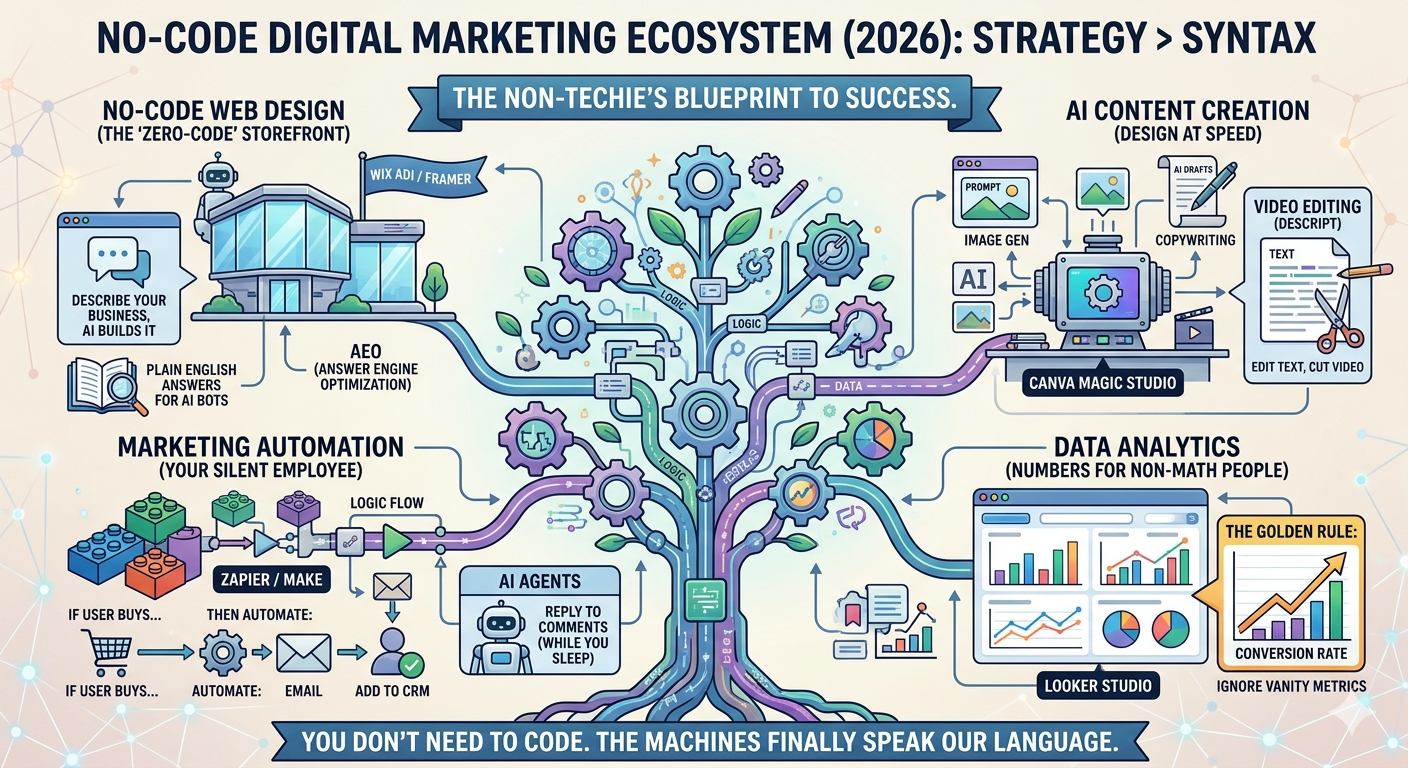
Gone are the days of staring at a “404 Error” in a sea of brackets. Modern website builders like Wix ADI or Framer have replaced coding with conversation.
Instead of dragging boxes manually, you can now use AI-driven design. You describe your business—”I run a boutique floral shop that specializes in minimalist Japanese arrangements”—and the tool generates a layout, selects a color palette, and even drafts the initial copy.
The Strategy: Focus on AEO (Answer Engine Optimization). In 2026, people don’t just “search” Google; they ask AI assistants for answers. Ensure your site clearly answers “Who,” “What,” and “How much” in plain text so these bots can find and recommend you.
2. Content Creation: Design at the Speed of Thought
If Photoshop feels like a cockpit you aren’t trained to fly, you aren’t alone. The barrier to “professional-grade” visuals has vanished thanks to tools like Canva Magic Studio.
-
Visuals: Need a social media post? Type “A cozy coffee shop in the rain, cinematic lighting,” and the AI generates the image for you.
-
Video: Video is the king of 2026 marketing, but editing is hard. Tools like Descript allow you to edit video by editing a text transcript. If you mess up a word in your recording, you just delete the word in the text, and the video cuts itself.
3. The “Silent Employee”: Automation
The most technical-sounding part of marketing is “integration”—getting your website to talk to your email list, which then talks to your CRM.
Enter Zapier and Make. Think of these as digital Lego bricks. You can set up a “Zap” that says: “When someone buys a product on my site, send them a thank-you email and add a task to my to-do list.” You don’t need to write the code that connects them; you just click the “Connect” button.
4. Data Without the Math Headache
You don’t need to be a data scientist to understand if your marketing is working. Tools like Looker Studio now offer “One-Click Dashboards.” You connect your Instagram or Google account, and it turns your raw numbers into easy-to-read charts.
The Golden Rule: Don’t get distracted by “Vanity Metrics” like likes or followers. In the no-code world, the only number that truly matters is your Conversion Rate: How many people went from “just looking” to “buying”?
The Takeaway: Strategy > Syntax
The tools of 2026 have leveled the playing field. When everyone has access to AI-generated images and no-code websites, the winner isn’t the person with the best technical skills—it’s the person who understands their customer the best.
Your “code” is your creativity. Your “syntax” is your brand’s voice. Don’t let the tech intimidate you; the machines are finally speaking our language.